
Outdoor privacy screens Toronto: the practical guide
Outdoor privacy screens Toronto homeowners choose are usually about one thing: blocking neighbour sightlines without turning the space into a dark box. This guide focuses on what actually works on Toronto lots, how to choose a privacy level and pattern, and what typically affects pricing and installation.
Want to see every design and option in one place? Start here: OutdoorPrivacyScreens.ca homepage.
Who this guide is for
If you’re trying to solve privacy in a real Toronto layout (and not a wide suburban lot), this page is for you:
- Homeowners in semis, townhomes, and narrow-lot properties dealing with close neighbours
- Condo and stacked-townhouse owners planning balcony privacy (subject to condo rules)
- Contractors and designers planning deck, patio, pergola, or pool/hot tub changes
How to choose the right screen
- Identify the sightline (side neighbour, laneway, or second-storey looking down).
- Pick privacy level (semi-privacy for airflow vs full privacy for total block).
- Confirm placement constraints (deck vs yard vs pool area rules).
- Choose a pattern that matches the privacy you need.
- Measure your run and request a quote for the correct posts/mounting.
Common Toronto privacy problems
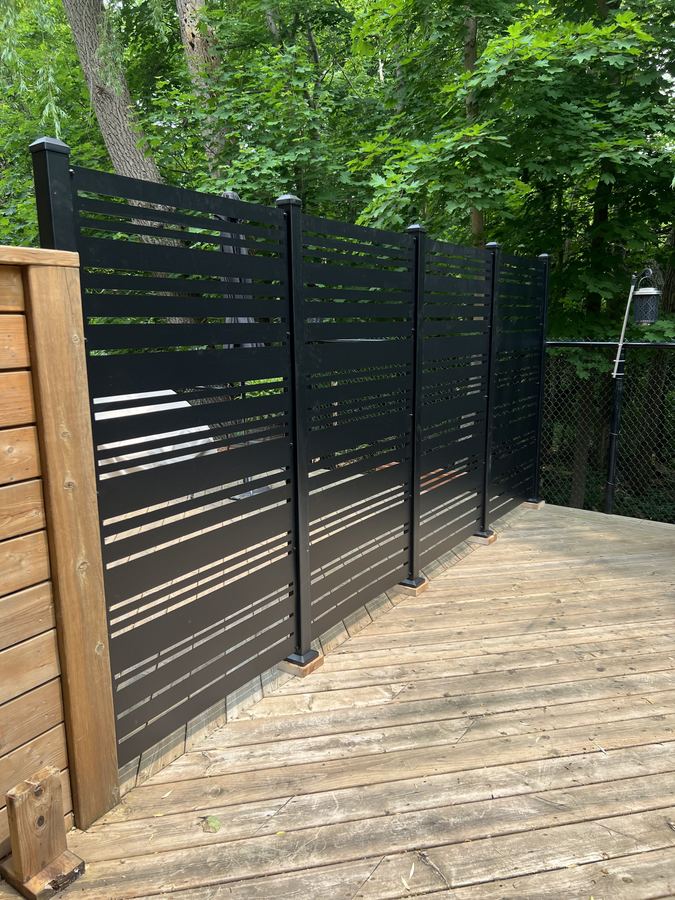
Toronto privacy challenges are usually caused by the lot shape and building height — not the size of your yard. Start with the sightline and choose the least “heavy” solution that still solves it.
We often help homeowners in East York, Etobicoke, North York, Scarborough, and downtown Toronto.
- Side neighbour at eye level: semi-privacy at seated height often solves this without closing in the space.
- Second-storey window looking down: you may need full height coverage, a tighter pattern, or an overhead element (pergola/shade) depending on the angle.
- Condo balcony exposure: condo rules matter more than municipal rules for attachments and appearance.
- Laneway behind: rear-yard placement can often achieve full privacy with the right height and panel density.
Semi-privacy vs full privacy
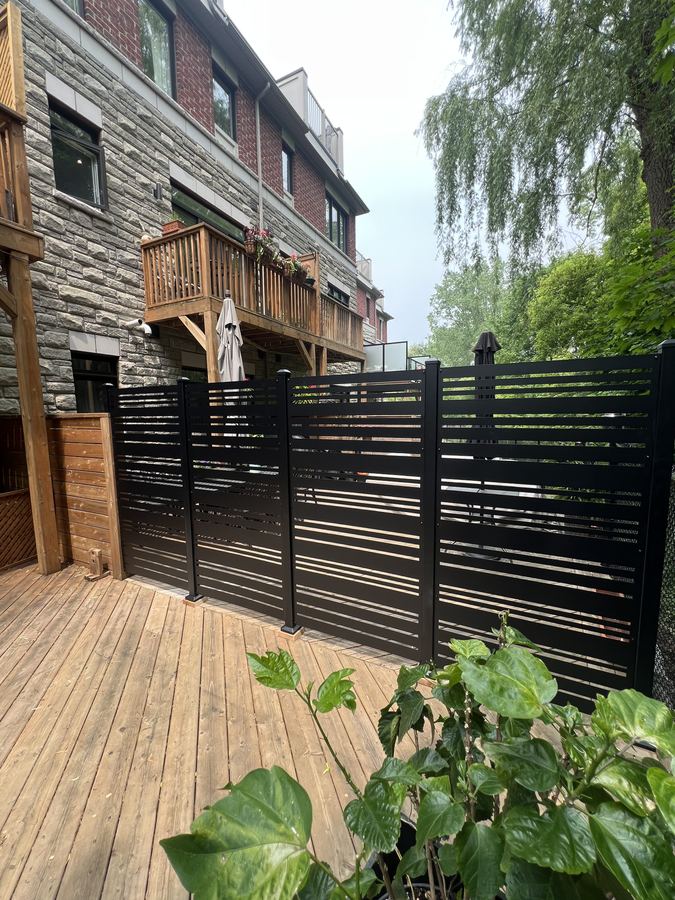
Semi-privacy uses patterns or slats that disrupt visibility while still allowing light and air through. In many Toronto deck installs, this feels more open and performs better in wind.
Full privacy is a solid or near-solid solution for direct window-to-window exposure or when you want total separation around seating or hot tubs.
See options: Semi Privacy Screen and Full Privacy Screen.
Choosing a pattern for a Toronto deck
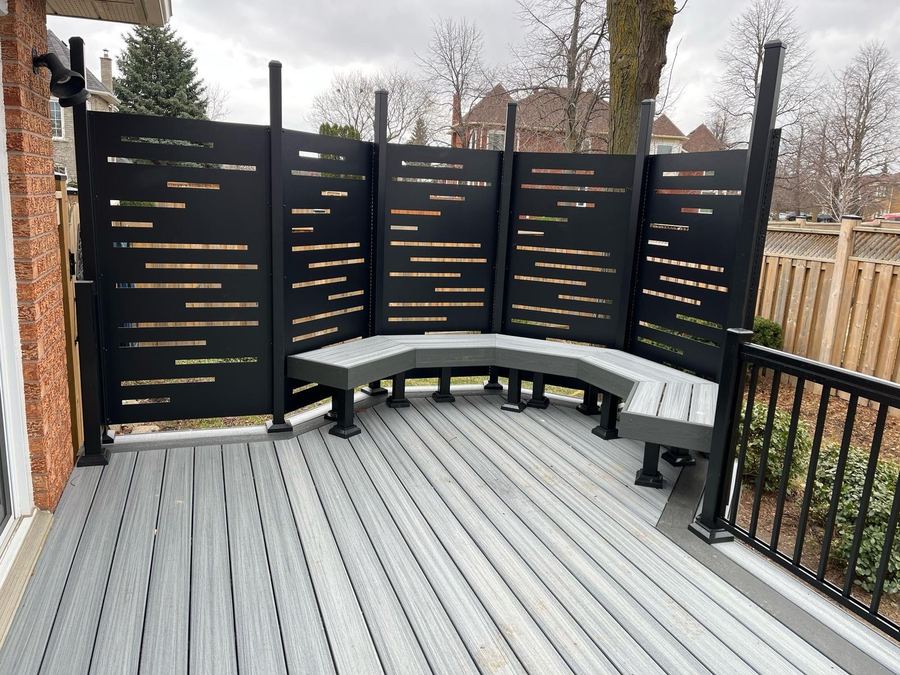
The spacing and geometry determine what remains visible at different angles. To compare designs realistically, use the Privacy Screen Visibility Tool.
Aluminum vs wood in Toronto weather
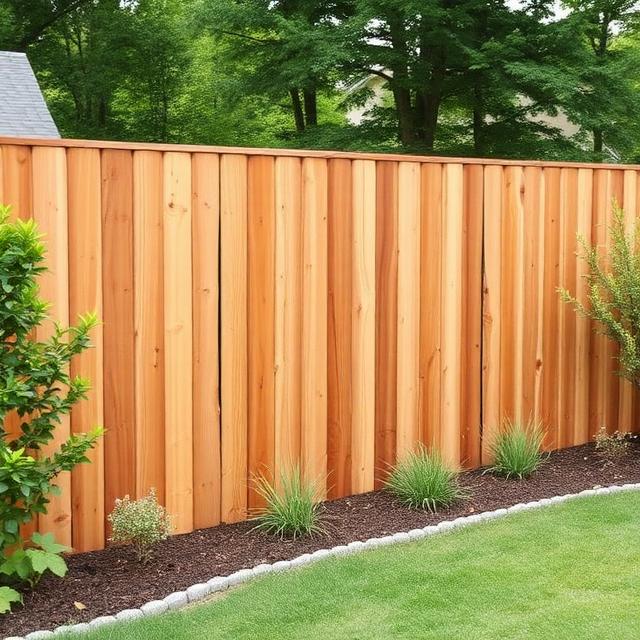
Wood fence
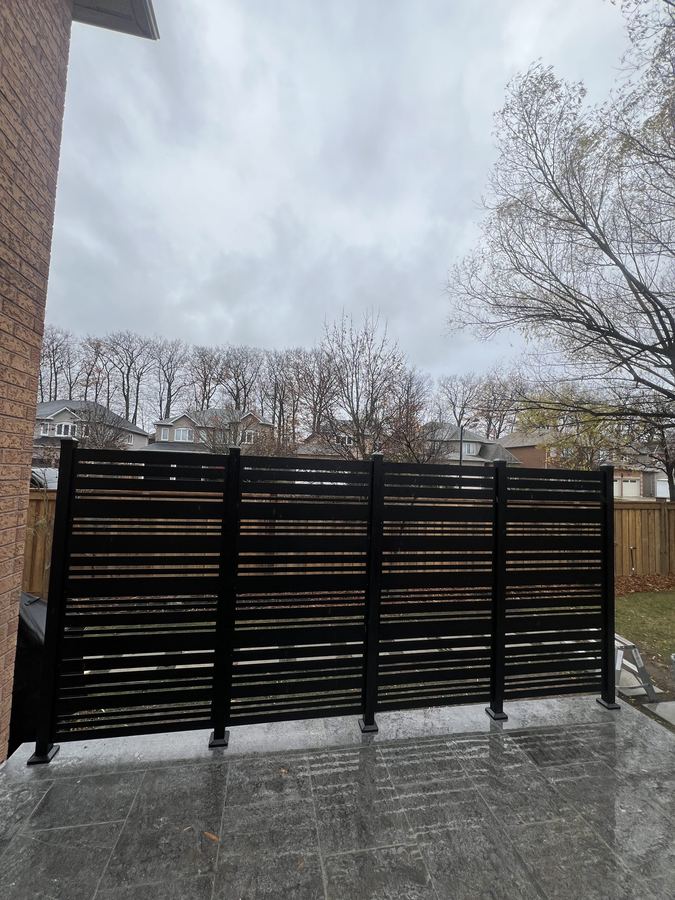
Aluminum
Wood can work, but it commonly moves with humidity and freeze-thaw cycles, which can open gaps over time. Most wood installs also require sealing or repainting to keep a clean look.
Powder-coated aluminum generally stays straighter, doesn’t absorb moisture, and keeps a consistent finish with minimal maintenance — which is why it’s a popular long-term choice in the GTA.
Toronto privacy screen bylaws
Toronto’s Municipal Code Chapter 447 (Fences) is commonly referenced for privacy screens. However, exact allowances can vary depending on your property conditions and how the screen is placed. Official reference: City of Toronto — Municipal Code Chapter 447 (PDF).
Deck rules (attached, unroofed)
Chapter 447 generally indicates a maximum height of 2.0 m for fencing measured from the deck surface in common attached, unroofed deck scenarios. In many cases, homeowners proceed without a permit when staying within typical fence rules; if your build is unusual (structural attachment, wind exposure, or enclosure requirements), confirm before installing.
Backyard fence rules (rear / side / front)
Guidance commonly cited under Chapter 447 is up to 2.0 m in side and rear yards, with some conditions allowing up to 2.5 m (such as certain lane or non-residential adjacencies). Front-yard limits are often lower unless specific setbacks apply. Because lot lines and conditions vary, treat these as general guidance and verify your scenario.
Corner lots, sight triangles, and visibility
Corner lots often have stricter street-facing limits due to visibility/sightline considerations. If you’re on a corner, confirm the street-facing side yard condition before finalizing height and placement.
Pool enclosures and permits
If the screen forms part of a required pool enclosure, additional enclosure rules and permitting can apply beyond general fence guidance. Hot tub situations can be different depending on cover type and permanence—so it’s worth confirming your exact setup.
Height rules at a glance (general guidance)
| Location | Common guidance | Notes |
|---|---|---|
| Attached, unroofed deck | Often referenced as up to 2.0 m from deck surface | Confirm if structure/enclosure conditions apply |
| Rear/side yard fence (on grade) | Commonly cited up to 2.0 m | Some conditions may allow higher (e.g., lane adjacency) |
| Front yard / street-facing | Often lower than rear/side | Setbacks and corner conditions matter |
| Pool enclosure | Enclosure rules may apply | Permits/specs can be required depending on pool type |
This table is simplified guidance for typical scenarios. For the official language, see Chapter 447 (PDF) linked above.
Pricing and install options
What affects pricing most
Pricing varies by height, width, posts/mounting, finish, and whether you’re ordering panel-only vs a full kit + delivery + installation.
Simple-geometry designs often start around $259, and more complex designs often start higher. Semi-privacy and full-privacy slat systems are typically priced differently due to framing and components.
Total installed pricing commonly depends on run length, height, mounting surface, post spacing, and access. If you want accurate pricing, the fastest path is to send measurements and a photo of the install area.
Use the checklist below, then request a quote. For installation guidance, see installation guides.
Deck vs backyard vs balcony
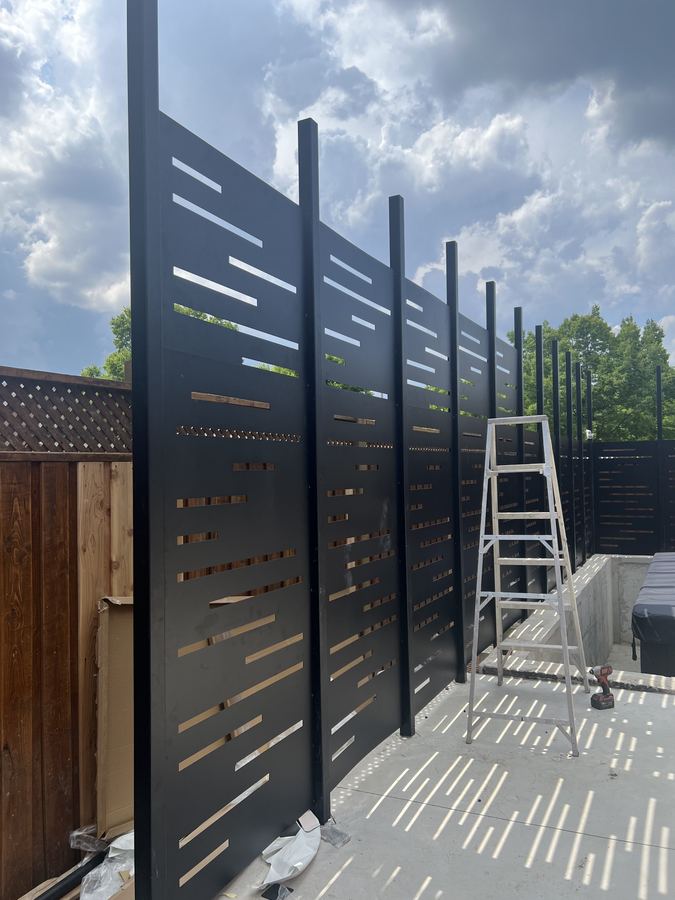
Rules and constraints can change based on where you’re installing. In practice, deck installs tend to be height-sensitive, backyard installs tend to be lot-line sensitive, and balconies tend to be governed by condo rules.
- Deck: confirm measurement point (deck surface) and wind exposure before choosing height and attachment method.
- Backyard: verify lot lines and street-facing or corner conditions before finalizing height.
- Balcony: confirm condo rules for attachment, appearance, and wind profile before ordering.
Quote checklist
- Overall run length and desired height (or the sightline you want blocked).
- A photo from the seating area looking toward the privacy issue.
- Your mounting situation (railing, concrete, freestanding, deck frame).
- Finish preference (black/bronze or a custom match).
FAQ
Can I put a privacy screen on my deck without a permit?
Often, homeowners proceed without a permit when the installation follows typical fence guidance and stays within commonly cited height limits. However, conditions vary (attachment method, enclosure requirements, and unusual structures), so it’s smart to verify your specific scenario against Chapter 447. Reference: Chapter 447 (PDF).
How tall can a privacy screen be on a deck in Toronto?
Chapter 447 is commonly interpreted as allowing up to about 2.0 m in many attached, unroofed deck situations, measured from the deck surface. Your property conditions and placement can affect what’s appropriate, so confirm before building if you’re near the limit.
Do privacy screens count as “fences” under Toronto rules?
In many practical cases, privacy screens are treated similarly to fencing when they divide space or block sightlines. Exact interpretation can depend on how the structure is built and where it sits on the property, so review Chapter 447 for the official language.
What works if a neighbour can see down from a second storey?
A seated-height semi-privacy screen may not fully block a downward angle. Depending on the sightline, you may need more height, a tighter pattern, or an overhead element (pergola/shade) to close the angle without creating a full wall.
What’s the best material for Toronto weather?
For low maintenance, powder-coated aluminum is a popular choice because it generally won’t rot, absorb moisture, or require regular sealing. Wood can work, but it typically needs more upkeep and may move over time in freeze-thaw conditions.
How much do outdoor privacy screens usually cost in Toronto?
Costs vary by size, mounting, post spacing, finish, and whether you’re buying panel-only or a full kit plus installation. If you send your run length, desired height, and a photo, you can usually get a reliable quote quickly rather than guessing from averages.